


When repair bills start climbing past what your car is actually worth, most owners hit a wall. You cannot keep pouring money into a vehicle that’s costing more to keep than it would to replace. Every year, roughly 1.6 million end-of-life vehicles come off Canadian roads,¹ and most owners have the same question: what’s the easiest way to get paid fairly and move on? Selling your car to a junkyard is one of the most practical answers. It skips the listings, the lowball offers, and the waiting.
This guide walks you through exactly how the process works, what your car is worth, what documents you need, and how to avoid the common mistakes that cost sellers hundreds of dollars.
Junkyard, Salvage Yard, or Cash for Cars: Which One Should You Use?
Not every place that buys junk cars operates the same way, and the type of buyer you choose directly affects your payout. Understanding the difference before you call anyone saves time and money.
Standard salvage yards buy cars quickly and handle towing, but they price offers based almost entirely on scrap metal weight. In Alberta, most standard salvage yards top out at $300 to $500 for passenger vehicles.²
Scrap metal yards pay for raw material only. Since the average mid-size car weighs around 1.3 tonnes, the payout at base scrap rates rarely exceeds $200 to $300.³
Cash for cars services and licensed auto recyclers assess salvageable parts on top of metal weight, which is why they regularly pay $1,000 to $5,000 or more for trucks, SUVs, or vehicles with intact high-value components.² Running vehicles typically appraise 30 to 50 percent higher than non-running equivalents.⁴ For most Alberta owners looking to sell car to salvage yard or cash for cars services, this tier almost always produces the strongest offer.
The core difference comes down to how they value your vehicle. A standard junkyard sees a pile of metal. A licensed auto recycler sees an engine, a catalytic converter, a set of alloy wheels, and a transmission, each with its own resale value on top of the scrap weight.

How Junkyards Price Your Car
Before you contact anyone, it helps to know what they are actually looking at when they make an offer. Several factors drive the final number.
| Factor | Impact on Value |
|---|---|
| Vehicle Weight | Heavier Trucks and SUVs Contain More Recyclable Metal |
| Running Condition | A Running Vehicle Is Worth 30–50% More Than a Non-Running Vehicle |
| Make and Model | High-Demand Models (Honda Civic, Toyota Corolla, Ford F-150) Have Stronger Parts Resale Value |
| Catalytic Converter | Contains Platinum and Rhodium; Adds $100 to $500 Alone |
| Engine and Transmission | Even Non-Running Engines Add Significant Value |
| Alloy Wheels | Aluminum Fetches More Per Pound Than Steel |
| Location | Urban Areas Like Calgary Generate More Competitive Offers Due to Recycler Density |
As a general benchmark for Alberta in 2026:
- Sedans: $150 to $800
- SUVs: $300 to $1,500
- Trucks: $500 to $2,500+
Knowing these figures going in means you can recognize a lowball offer when you see one, and push back with confidence.
Related Post:
How to Sell a Car to a Junkyard: Step by Step
Selling a car to a junkyard is usually a straightforward process when you know what to expect. From gathering ownership documents and getting a quote to arranging pickup and receiving payment, following the right steps can help you sell your vehicle quickly and avoid unnecessary delays.
One important note: if your vehicle has an active lien, it cannot be sold until the lien is discharged or you are selling through a licensed dealer.
1. Confirm You Have the Title
A vehicle title in your name is the single most important document when selling to a junkyard. Without it, no reputable buyer will complete the transaction. If you have lost yours, contact Alberta’s registry office to request a replacement. The process requires a valid ID and a small fee.
One important note: if your vehicle has an active lien, it cannot be sold until the lien is discharged or you are selling through a licensed dealer.
2. Get Quotes from Multiple Buyers
Do not accept the first offer you receive. Contact five to six local buyers, including salvage yards and cash-for-cars services. Provide accurate information: make, model, year, condition, and any damage. This comparison takes less than an hour and can realistically add hundreds of dollars to your final payout.
Any reputable buyer will come to your location to collect the vehicle. You should never pay for towing when selling to a junkyard.
3. Select the Best Offer and Book Pickup
Once you have several quotes, choose the strongest offer and confirm the pickup time. If your car still runs, some buyers may ask you to drive it in. Non-running vehicles will be towed at no cost to you.
4. Pass the Vehicle Inspection
When the buyer arrives, or when you drop the vehicle off, it will be inspected before final payment is issued. This is standard practice and usually takes only a few minutes. As long as the vehicle condition matches what you described, the agreed price stands.
5. Sign the Paperwork and Collect Payment
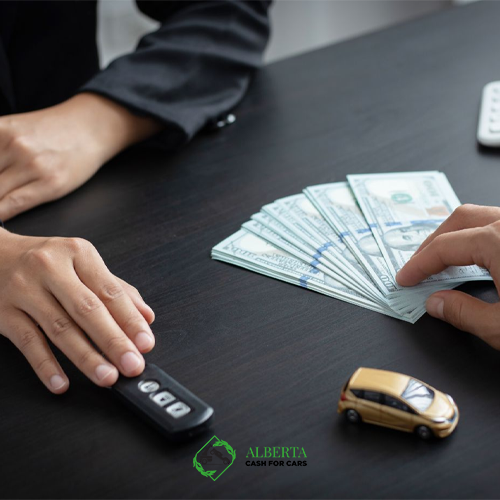
Sign over the title and complete a basic bill of sale. Keep a copy for your records. Most reputable services pay cash on the spot or via immediate e-transfer. Once payment is received, the transaction is complete.
Keep your license plates. In Alberta, plates stay with you, not the vehicle.
6. Notify the Registry Within Two Days
After selling to a junkyard, contact Alberta’s vehicle registry to confirm the sale. This removes the vehicle from your name, ends your liability for anything that happens to it afterward, and stops the registration from appearing on your property tax record. If you cancel your insurance before the registration transfer is processed, you could face a gap in your records.
What Documents Do You Need to Sell a Car to a Junkyard?
The paperwork for selling a car to a junkyard is minimal compared to a private sale. In Alberta, you generally need:
- Vehicle title (certificate of ownership) in your name
- Valid government-issued photo ID
- Bill of sale (typically prepared by the buyer)
Some circumstances also require a junk title application or a non-repairable vehicle certificate if the car has been officially written off. A reputable buyer will walk you through any province-specific requirements that apply to your situation.
Why Selling to a Junkyard Beats Most Alternatives
A lot of owners wonder whether they would get more by listing the car privately or sitting on it for a better offer. Here is how those options actually compare.
| Factor | Junkyard / Recycler | Private Sale |
|---|---|---|
| Speed | Same Day or Next Day | Days to Weeks |
| Advertising Cost | None | Yes |
| Towing Cost | Free | Your Responsibility |
| Negotiation Required | Minimal | Yes |
| Payment Risk | Low (Reputable Buyer) | Higher (Fake Bills, Bad Checks) |
| Paperwork Complexity | Simple | More Involved |
The time cost alone makes selling a car to a junkyard the stronger option for most people. Private listings require cleaning the vehicle, photographing it, managing inquiries, scheduling viewings, and then still negotiating. For a car that is non-running or heavily damaged, that effort rarely produces a meaningfully better result.
If the Junkyard Offer Feels Low: Selling a Car Privately
If you believe your vehicle still has enough cosmetic or mechanical value that a junkyard offer does not reflect it, selling a car privately is worth considering. It is more work, but it can occasionally produce a better return for the right vehicle.
A few important points if you go that route:
Prepare the vehicle properly. Private buyers respond to presentation in a way junkyard buyers do not. Clean the car thoroughly, document the VIN, mileage, and known condition issues, and take clear photos before listing.
Use digital payment. Large-denomination bills can be counterfeited, and there is no reliable way to verify them without a bill tester. Verified digital transfers confirm the payer’s identity and leave a record for both parties.
Guard your personal information. Keep location details out of public listings until you are comfortable with a specific buyer. During test drives, hold onto their driver’s license or take a copy.
Transfer ownership in writing. When selling a car privately, both a signed title and a bill of sale are required. Notify the Alberta registry immediately after the sale so the vehicle is removed from your name.
The key thing to understand about selling a car privately versus selling to a junkyard is the risk trade-off. Private sales can pay more, but they also carry more exposure: payment fraud, no-shows, and delayed ownership transfers are all common. For a vehicle that is damaged, non-running, or simply old, that trade-off rarely justifies the extra effort.
Ready to Sell Your Car?
If your vehicle is sitting on your property costing you money in insurance, storage, or repairs you keep avoiding, the fastest way to find out what it’s worth is to get a quote. Alberta Cash for Cars buys vehicles in any condition, running or not, with free towing and same-day payment.
Call us at +1 (587) 844-2274 or email [email protected] to get your free quote and book a pickup time that works for you.
Conclusion
Selling a car to a junkyard is one of the most practical ways to handle a vehicle that has run its course. The process is faster than a private sale, requires less paperwork, and comes with free towing when you choose a reputable buyer. The difference between a fair payout and a disappointing one usually comes down to two things: knowing how junkyards price vehicles and getting quotes from more than one buyer before committing. If the offers still feel low and your car has genuine resale value in its parts or appearance, selling a car privately is a viable fallback, though it carries more risk and takes more time. Either way, an end-of-life vehicle sitting on your property costs you money. Getting it to a licensed recycler turns that cost into cash and keeps one more car out of a landfill.
FAQs
Do I need a title to sell my car to a junkyard in Alberta?
Will the junkyard tow my car for free?
How long does the process take?
What is my junk car worth in Calgary?
Do I keep my license plates when selling to a junkyard?
What should I do after selling my car?
Sources
Alberta Cash for Cars uses only trusted, high-quality sources to ensure the information in our articles is accurate, reliable, and up to date.
- Canadian Auto Recycler — The Low-Down on Canada’s Automotive Recycling Industry https://canadianrecycler.ca/the-low-down-on-canadas-automotive-recycling-industry/
- Scrap Car Buyer Toronto — Average Payout for Scrap Cars in Canadian Provinces (2026) https://www.scrapcarbuyertoronto.ca/blog/what-is-the-average-payout-for-scrap-cars-in-canadian-provinces/
- CarsBuyer.ca — Understanding Your Vehicle’s Value in 2025 https://www.carsbuyer.ca/post/understanding-your-vehicle-s-value-in-2025-how-much-to-junk-my-car
- Cash For Cars Canada — Scrap & Junk Car Value Calculator Canada (2026) https://www.cashforacar.ca/scrap-car-value-calculator/
- Sellmax — Eco-Friendly Car Recycling Statistics & Facts https://sellmax.com/car-recycling/
- Lookupaplate — Automotive Recycling Statistics and Trends (2025 Update) https://www.lookupaplate.com/blog/automotive-recycling-statistics/
- Automotive Recyclers Association of Atlantic Canada — Good for the Earth https://araac.ca/green-recycled-parts/good-for-the-earth/