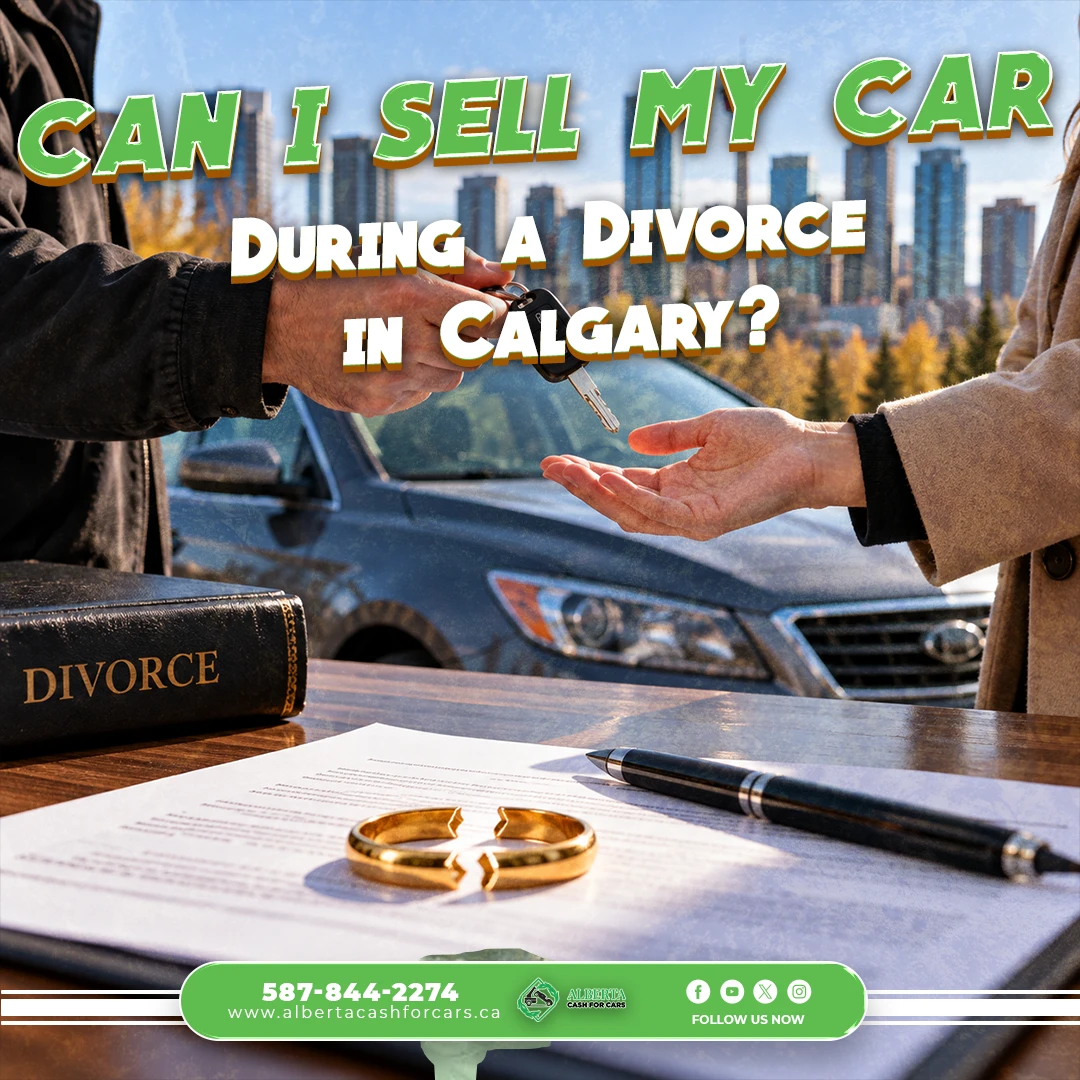



You have a car in the driveway, a separation underway, and a buyer waiting on an answer, but you’re not sure if selling it right now is even yours to decide. That uncertainty is exactly where people get into trouble, either sitting on a decision they were actually free to make, or selling something that should have waited and creating a legal headache in the process.
Whether you can sell a car during a divorce in Calgary depends on a few things: who owns the vehicle, whether it’s tied up in unresolved property division, and whether a separation agreement or court order affects it. This guide walks through the common ownership scenarios, what typically needs to be resolved first, and when it’s worth talking to a family lawyer before doing anything with the vehicle.
Selling a Car During a Separation?
Once ownership and consent are sorted, get a condition-based offer. Alberta Cash for Cars buys vehicles across Calgary and more than 50 Alberta communities, with free pickup included.
What Determines Whether You Can Sell a Car During a Divorce in Calgary?
What happens to a car during divorce in Alberta comes down to three separate things that affect whether you can sell it: vehicle registration, legal ownership, and family property status. These aren’t the same thing, and conflating them is where people run into trouble.
Registration shows who is listed as the registered owner, but it doesn’t by itself answer every question about legal ownership or family-property rights.
Legal ownership is who actually owns the asset. In many cases this matches registration, but not always, particularly with jointly used vehicles or vehicles purchased with shared funds even if only one spouse’s name ended up on the paperwork.
Family property status is a separate legal question entirely. Under Alberta’s Family Property Act, most property acquired by spouses or adult interdependent partners during the relationship is presumptively divisible when the relationship ends, and this can include vehicles regardless of whose name is on the registration.
A vehicle registered solely in one spouse’s name can still be family property if it was acquired during the relationship. That doesn’t mean it can never be sold, but it does mean the registered owner isn’t automatically free to sell it without considering how that affects the other spouse’s claim. All three factors need to line up before a sale is straightforward.

Can I Sell a Car That's Solely Owned and Not Part of a Dispute?
If the vehicle was owned before the relationship began, was acquired through an exemption such as an inheritance, and there’s no dispute or ongoing property division process, selling it is generally more straightforward. Exempt property under the Family Property Act is not automatically divisible, though the exemption depends on how the asset has been treated during the relationship and can be lost if it’s been mixed with shared property.
Where there’s no active proceeding, no disagreement, and clear evidence the vehicle falls outside family property, the registered owner typically has more flexibility to sell without needing consent from the other spouse. That said, if there’s any ambiguity about whether the vehicle qualifies as exempt, getting that confirmed before selling avoids complications later.
Can I Sell a Jointly Owned Vehicle During a Divorce?
Selling a jointly owned car during divorce means both spouses are listed as registered owners, so both will generally need to participate in the transfer process. This is a practical registry consideration separate from the family property question, since a registry agent typically requires the necessary signatures from all registered owners.
Even setting aside the registry mechanics, selling a jointly owned vehicle unilaterally during a separation can create legal complications if the other spouse hasn’t agreed to the sale. If you and your spouse are both on the registration and you don’t have an agreement in place about the vehicle, getting written consent, or resolving the question through your separation agreement or legal counsel, is the safer path before pursuing a sale.
What If the Car Is Part of the Divorce Settlement or Unresolved Property Division?
Can I sell a car that is part of a divorce settlement before it’s finalized? If the vehicle’s status hasn’t been settled through a separation agreement or court order, selling it can affect the property division process. Alberta’s Family Property Act includes provisions specifically aimed at preventing one spouse from disposing of property in a way that could defeat the other spouse’s claim.
Under the Act, a court can restrain a spouse from transferring or disposing of property if the court is satisfied that the transfer is intended to defeat the other spouse’s claim under the Act. Separately, once proceedings have been commenced, there are restrictions on disposing of certain property without a court order or the other spouse’s consent, and doing so can carry legal consequences.
The takeaway: if the vehicle’s ownership and division status haven’t been resolved, selling it before that resolution is reached carries real legal risk. This is exactly the kind of situation where speaking with a family lawyer before acting protects you.
Can One Spouse Sell a Vehicle Without the Other's Consent?
Not necessarily, and there’s no blanket rule that covers every situation. Whether one spouse can sell without the other’s consent depends on registration, whether the vehicle is family property, whether proceedings have been commenced, and whether any separation agreement or court order already addresses the vehicle.
It’s not accurate to say a registered owner can always sell simply because their name is on the registration. It’s equally inaccurate to say a spouse’s consent is always required in every case. The right answer depends on the specific facts, which is precisely why this question is worth confirming with a family lawyer rather than assuming based on registration alone, especially if the sale is happening while property division remains unresolved.
Here’s a general sense of how common scenarios tend to play out, though every situation should be confirmed against your own facts:
| Situation | Typical Position |
|---|---|
| Solely owned, acquired before the relationship, no dispute | Registered owner generally has more flexibility to sell |
| Solely owned, but acquired during the relationship | May still be family property; consult before selling |
| Jointly registered | Both parties' consent generally required to complete a transfer |
| Part of an unresolved property division | Selling before resolution carries legal risk |
| Addressed in a signed separation agreement or court order | Follow the terms of that agreement or order |
This table is a general guide, not a substitute for legal advice specific to your situation.
What Happens If There's Still a Loan on the Car?
An outstanding loan adds another layer regardless of the divorce situation. Any registered lien needs to be addressed as part of the sale so the buyer doesn’t acquire the vehicle subject to the seller’s secured debt. The parties should confirm how the lender will be paid out and the lien released before completing the transaction, whether the sale is straightforward or complicated by a separation.
If you’re navigating both an active loan and a property division question, knowing how to sell a car that still has payments is worth understanding before the loan payout gets folded into how sale proceeds are handled between spouses.
How Is a Car Valued During a Divorce?
Getting an accurate value for the vehicle matters for two reasons: it affects what you’d actually receive from a sale, and it factors into how the vehicle is treated in property division discussions. Value typically depends on the vehicle’s make, model, year, condition, mileage, and current market conditions in Alberta.
It’s worth distinguishing between market value, what the vehicle would sell for, and equity, market value minus any amount still owed on a loan. These aren’t the same number, and conflating them can lead to inaccurate assumptions about what a sale would actually net. Getting an accurate used car valuation in Alberta before agreeing on a number avoids that mistake.
Can Both Spouses Agree to Sell the Car for Cash?
Yes, and when both spouses agree, this is generally the most straightforward path. If both registered owners consent to the sale and there’s agreement on how the proceeds will be handled, whether that’s split between spouses, applied to a shared debt, or addressed through the broader settlement, the sale itself proceeds like any other vehicle transaction.
Getting that agreement in writing before completing the sale is a reasonable step, even if it’s informal, since it creates a clear record of what was agreed to and reduces the chance of disputes after the fact.
What Paperwork Is Needed to Sell the Vehicle?
The standard documentation for a vehicle sale in Alberta applies here too:
- Proof of ownership
- Valid government-issued ID
- Completed bill of sale
If the vehicle is jointly registered, both parties typically need to be involved in completing the transfer car ownership Alberta process, and knowing the full paperwork needed to sell a car ahead of time keeps things moving smoothly. If there’s any uncertainty about whether you have the legal standing to complete the sale on your own, that’s worth resolving with a family lawyer before starting the paperwork.
Steps to Take Before Selling a Car During a Divorce
Once you’re ready to move forward, working through these steps in order reduces the chance of complications later.
- Confirm registration and ownership. Check whose name is on the vehicle registration and whether the vehicle was acquired before or during the relationship.
- Determine family property status. Establish whether the vehicle is likely to be considered divisible family property under the Act, or whether it may qualify as exempt.
- Check for any existing agreement or order. Review your separation agreement or any court order to see whether the vehicle has already been addressed.
- Get consent in writing if jointly owned. If both spouses are registered owners, secure written agreement before proceeding with a sale.
- Address any registered lien. Confirm whether a lien is registered against the vehicle and how it will be paid out and released.
- Get an accurate valuation. Know the vehicle’s current market value and equity position before agreeing on a sale price.
- Consult a family lawyer if anything is unresolved. If ownership, consent, or property division status is unclear, get advice before completing the sale.
- Complete the sale and documentation. Once everything above is resolved, the sale itself proceeds like any standard vehicle transaction in Alberta.

Frequently Asked Questions
Can I sell my car during a divorce in Calgary?
Can I sell a jointly owned car during a divorce?
What if the car is part of the divorce settlement?
Can one spouse sell a vehicle without the other's consent?
What happens if there's still a loan on the car?
Considering Selling a Vehicle During a Divorce in Calgary?
If you and the other registered owner have agreed on selling the vehicle, we can give you a straightforward, no-pressure quote based on the vehicle’s actual condition. We know this is often one of many practical decisions during a difficult time, and we try to make the vehicle part of it as simple as possible. Email us at [email protected] and we’ll walk you through the process, including how we handle situations involving joint ownership or an outstanding loan.
Conclusion
Whether you can sell a car during a divorce in Calgary comes down to ownership, whether the vehicle is part of unresolved family property, and whether any agreement or court order already addresses it. The core question of how to sell a car during divorce in Calgary always starts with confirming who has the legal authority to sell the vehicle. A solely owned vehicle with no dispute is usually straightforward to sell. A jointly owned vehicle, or one tied up in an unresolved property division, carries more risk if sold without the other spouse’s consent or without confirming your legal position first.
Alberta’s Family Property Act includes real protections against one spouse disposing of property in a way that could defeat the other’s claim, so this isn’t a question to guess your way through. If ownership is disputed, the vehicle is jointly owned, it’s part of a settlement, or a court order may apply, get advice from a family lawyer before selling. Once that’s resolved, selling the vehicle itself is a standard process, whether that’s a private sale, a dealer trade-in, or a direct cash buyer.
References
Sources
Alberta Cash for Cars uses only trusted, high-quality sources to ensure the information in our articles is accurate, reliable, and up to date.
- Government of Alberta. Family Law Legislation. . Accessed August 2026. (Used for: overview of the Family Property Act’s role in Alberta family law and its application to married and adult interdependent partners.)
https://www.alberta.ca/family-law-legislation - Alberta King’s Printer. Family Property Act, RSA 2000, c F-4.7. . Accessed August 2026. (Used for: Section 34 provisions restraining transfers intended to defeat a spouse’s claim, and restrictions on disposing of property once proceedings have commenced.)
https://www.qp.alberta.ca/1266.cfm?page=F04P7.cfm&leg_type=Acts&isbncln=9780779807680&display=html - Centre for Public Legal Education Alberta (CPLEA). Rules for Dividing Everything Up. . Published February 3, 2025. (Used for: plain-language explanation of family property categories and presumptive division under the Family Property Act.)
https://family.cplea.ca/article/rules-for-dividing-everything-up/ - Government of Alberta. Personal Property Liens. . Accessed August 2026. (Used for: lien clearance requirement before ownership transfer applies regardless of divorce circumstances.)
https://www.alberta.ca/personal-property-liens - Government of Alberta. Transfer a Vehicle Registration. . Last updated July 8, 2026. (Used for: standard documentation and registry process requirements for completing a vehicle sale in Alberta.)
https://www.alberta.ca/transfer-vehicle-registration