




A shop calls with the diagnosis: head gasket. The quote that comes with it eats a big share of what the car is worth. Many owners at this point look into how to sell a car with a blown head gasket in Red Deer instead of paying for the repair. The car still has value, and the right call depends on the repair estimate, the car’s worth in good condition, its mileage, and whether overheating damaged anything beyond the gasket. A wrong guess can cost thousands either way. This guide covers what the failure means, how it affects value, when repairing pays off, and how selling works locally.
Quick answer: Yes, you can sell a car with a blown head gasket in Red Deer. It keeps value as-is, and buyers price it from what it would be worth repaired, minus the repair cost and the risk of hidden engine damage. Repairing usually pays off only on newer, valuable cars; older, high-mileage cars are often better sold as-is.
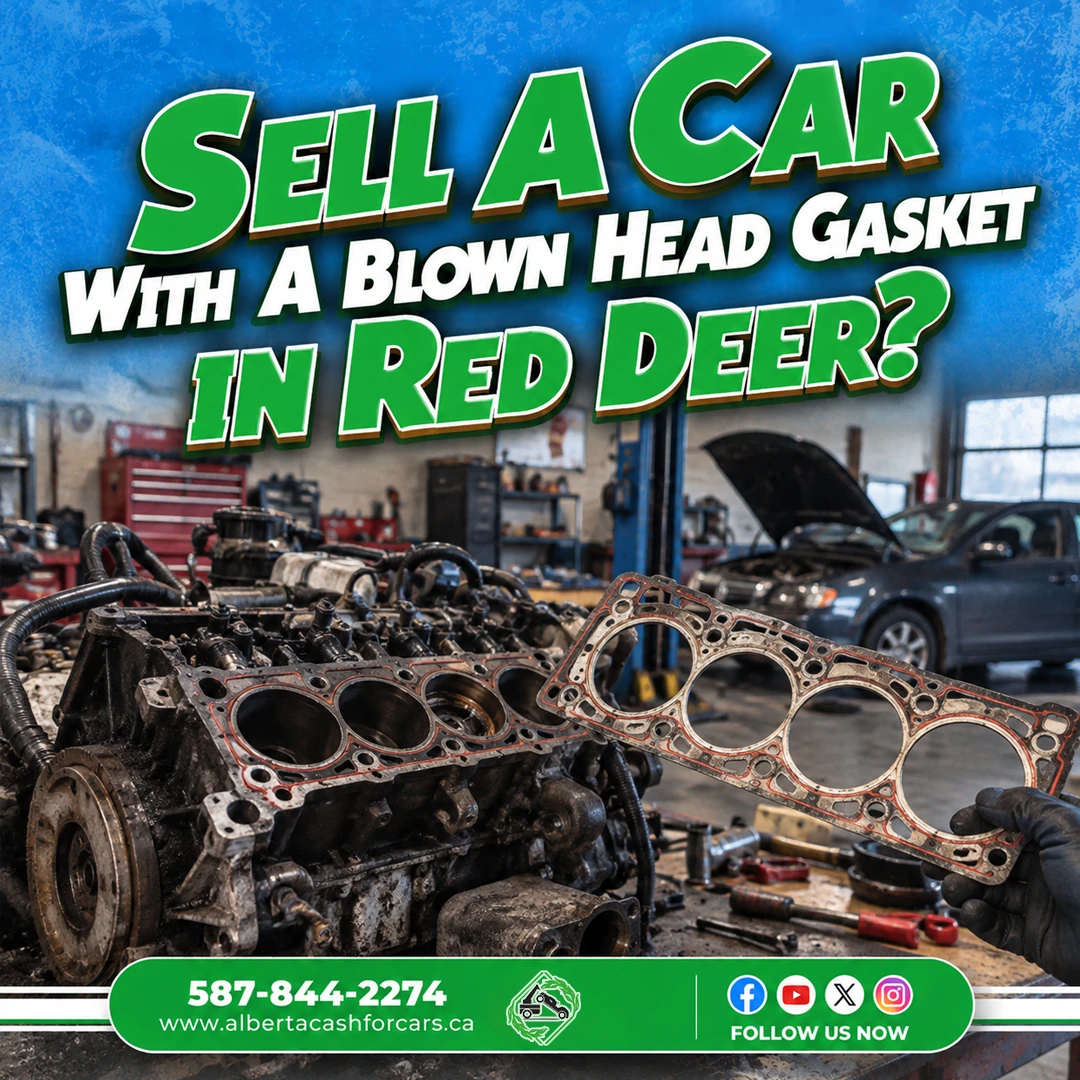
Blown Head Gasket in Red Deer?
Get a condition-based offer before paying for the repair. Alberta Cash for Cars buys vehicles running or not across Red Deer and more than 50 Alberta communities, with free pickup included.
Can I Sell a Car With a Blown Head Gasket in Red Deer?
Yes. You can sell a car with a blown head gasket in Red Deer, and the vehicle usually keeps real value to the right buyer. The failure lowers the price without erasing it. Buyers price in the repair, the chance of hidden engine damage, and the cost of moving a car that may not be drivable.
Whether selling beats repairing comes down to the same few variables each time:
- Repair cost versus car value: a quote that’s reasonable on a $20,000 SUV can be out of proportion on a $4,000 sedan.
- Age and mileage: an engine with 300,000 km on it is a bigger gamble to repair than one with 90,000 km.
- Overall condition: rust, worn suspension, a tired transmission, and body damage all weigh on the decision.
- Extent of engine damage: a gasket that failed quietly is a different problem from one that followed a serious overheating event.
Mechanics, flippers, parts buyers, and cash-for-cars companies all buy vehicles with this problem. Owners who want to sell a car with a bad head gasket should expect two questions first: has the problem been confirmed, and did the engine overheat? Anyone who plans to sell a car that needs a head gasket replacement should have both answers ready.

What Does a Blown Head Gasket Mean for Your Car?
The head gasket seals the joint between the engine block and the cylinder head. When it fails, coolant, oil, and combustion pressure can cross into places they shouldn’t. What the driver notices depends on where the seal gave way:
- Engine overheating: lost coolant or hot combustion gas can leave the cooling system unable to hold a normal temperature.
- Loss of coolant: the level keeps dropping, sometimes with no visible puddle, because coolant can leak into a cylinder.
- Coolant and oil mixing: the gasket keeps the two apart, so a failure can let them blend, which often shows up as milky engine oil.
- White exhaust smoke: coolant that enters a cylinder burns off and leaves the tailpipe as white smoke.
- Misfires and power loss: pressure escapes where it shouldn’t, so the engine runs rough and a check engine light may come on.
Confirmed or Just Suspected?
Symptoms point toward a diagnosis without proving one. Overheating and coolant loss can also come from a bad thermostat, a failing water pump, a leaking radiator, or a cooling fan problem. Alberta’s occupation profile explains that technicians locate faults with testing equipment, a test drive, or manufacturer specifications, then dismantle the faulty assembly to repair or replace damaged parts. For a suspected head gasket failure, that usually means testing first and sometimes removing the cylinder head to see what’s actually damaged.
This matters when you sell. If the failure is confirmed, say so and share the paperwork. If it’s only suspected, say that instead. Buyers can price uncertainty, but they react badly to surprises.
How Serious Is It? Head Gasket Failure vs. Engine Failure
A blown head gasket doesn’t automatically mean a blown engine, though the two can be linked. How far the damage went decides whether a repair makes sense.
Head Gasket Failure Alone
When the head and block turn out to be undamaged, the repair covers the gasket plus the other parts disturbed to open the top of the engine. Labour makes up much of the bill because the cylinder head has to be removed, and the total shifts with the engine, any head machining, and the related parts replaced. This is the best case, and it’s where fixing a newer, solid car can pay off. A shop often can’t promise it until the head is off.
Overheating Damage: Warped or Cracked Components
Once the head is off, a technician can see whether the head or block took damage. A head warped by heat has to be machined or replaced, and a crack in the head or block can be far more serious. Each finding adds parts and labour, and a damaged block can end the economics of a repair. A shop’s estimate before the head comes off is therefore a best-case figure. A car that overheated badly is a riskier repair than one that lost a little coolant.
Severe Internal Damage and a Failed Engine
If the damage reaches the engine’s internals, such as bearings, pistons, and cylinder walls, the job goes beyond a head gasket. It becomes an engine rebuild or replacement, and the car is usually valued as a project or parts vehicle. For that situation, see this guide on selling a car with a blown engine.
Blown Head Gasket Car Value: What Buyers Look At
Blown head gasket car value doesn’t follow a fixed percentage off the usual price. In practice, a buyer starts with what the car would be worth repaired, subtracts the repair, then subtracts a margin for risk and effort.
These factors move the number most:
- Cost of the repair: the larger the estimate, the lower the offer, especially when machine work or extra parts are involved.
- Age and mileage: older, high-mileage cars have less value to protect, so a big repair weighs more heavily.
- Mechanical condition and repair history: maintenance records, past overheating, and earlier engine work all matter.
- Make, model, and demand: popular models with easy parts supply attract more buyers.
- Whether it still runs: a car that can be driven onto a trailer is simpler to buy than one that can’t move.
- Extent of overheating damage: a suspected warped head lowers offers more than a simple gasket leak.
- Cosmetic condition: a clean interior and straight body panels still count.
For a wider look at when any repair stops making sense against a vehicle’s worth, read this breakdown of expensive car repairs. The two examples below show how different the math can look. All figures are hypothetical, made up to show the method. They aren’t quotes, Alberta averages, or sourced data.

An Older, High-Mileage Car
Say a 14-year-old sedan with 250,000 km would sell for about $3,500 running, and a buyer might pay about $1,200 as-is with the head gasket problem. A shop quotes $2,800 to replace the gasket and machine the head. Repairing leaves about $700 ($3,500 minus $2,800), against $1,200 for selling as-is. Even a flawless repair loses about $500 before selling costs. If the shop finds more damage once the head is off, the gap widens. Selling as-is looks stronger here.
A Newer Car in Good Condition
Now take a six-year-old SUV with 90,000 km, worth about $19,000 running, with the same diagnosis and a $3,500 quote. Suppose a buyer would pay about $9,000 as-is. Repairing leaves about $15,500 ($19,000 minus $3,500), against $9,000 for selling as-is, a difference of roughly $6,500 before selling costs. The repair uses under a fifth of the car’s value and restores a vehicle that’s otherwise sound. A written warranty on the work, when a shop offers one, gives a later buyer something to rely on. Repairing can make sense here, as long as the shop checks for overheating damage before starting.
Should I Repair a Blown Head Gasket Before Selling?
Not automatically. The real question is whether the car’s price rises by more than the repair costs once the risk is counted. This table lays out the two paths:
| Repair first | Sell as-is | |
|---|---|---|
| Upfront money | Required, often in the thousands | None |
| Buyer pool | Wider, since the car runs again | Narrower, priced for its condition |
| Timeline | Shop time, then listing time | Offers can arrive within days |
| Repair risk | You carry it if more damage turns up | The buyer carries it, reflected in the offer |
| Best fit | Newer car in solid shape with a limited problem | Older or high-mileage car, large estimate, or suspected overheating damage |
When Repairing Can Make Sense
Repairing tends to pay off when the car is worth enough to justify the bill and the rest of the vehicle is strong. Reasonable mileage, a clean maintenance history, and an estimate that’s a modest slice of the car’s running value all point that way. So does confidence that the problem stopped at the gasket. If a shop has pulled the head, found it flat and crack-free, and will warranty the work, the repaired car can sell on the open market at a much stronger price.
When Selling As-Is Usually Makes More Sense
Selling without repairs tends to win when the numbers or the risks stack up against the car. Look for these signs:
- The car is older with high mileage, so there’s little value to protect.
- The repair estimate is a large share of the car’s value.
- Other expensive problems are waiting, such as transmission, rust, or suspension issues.
- The engine overheated, which raises the odds of a warped head or deeper damage.
- The likely rise in sale price wouldn’t cover the repair bill.
A Simple Way to Run the Numbers
Work through this sequence before committing money:
- Get a written estimate with the scope itemized, including any head machining. Alberta law requires technicians who diagnose and repair vehicles to be registered apprentices, certified journeypersons, or holders of a recognized trade certificate, so it’s fair to ask who’ll do the work.
- Check what the car is worth in good running condition using comparable local listings or a valuation guide.
- Subtract the repair estimate from that value.
- Set aside a cushion for surprises, since more damage can surface once the head is off.
- Compare the result with offers for the car as-is.
If the as-is offer is close to or higher than what’s left after steps 3 and 4, selling without repairs is the stronger move. When the head gasket is only one of several problems, this guide to selling a car with mechanical problems covers the wider picture.
What If the Car Isn't Safe to Drive or Won't Run?
Driving an overheated engine can make the damage worse. If the temperature gauge spikes, the coolant keeps disappearing, or white smoke shows up after warm-up, stop and have the car towed rather than driving it to a shop or a buyer.
Be direct with buyers about the car’s actual state. Say whether it starts, how long it can idle before overheating, and whether it can be driven at all. A car that can’t be test-driven gets priced with towing and teardown costs in mind, so clear details lead to firmer offers. For the logistics of a car that can’t move, see this page on how to sell a non-running car. Some buyers include car removal in their offer, which changes the comparison against a private sale where you’d pay for the tow yourself.
How Do You Sell a Car With a Blown Head Gasket?
The process runs in a clear order, and skipping steps is where sellers lose money or time:
- Confirm the problem if possible. A written diagnosis isn’t required, but it gives buyers something concrete to price.
- Run the repair-versus-sell numbers. Use the steps above before paying for anything.
- Gather your documents. Photo ID, ownership paperwork, and any repair or diagnostic records.
- Describe the problem accurately. State what’s confirmed, what’s suspected, and whether the car overheated.
- Say whether it runs or needs a tow. This changes how buyers price it.
- Compare offers. Get more than one, and check each against the likely repair cost and the car’s realistic post-repair value.
- Complete the paperwork. Alberta requires a standard bill of sale in a private sale, signed by both sides, which lets the new owner licence and register the vehicle.
Documents to Have Ready
Bring valid photo ID and proof that you own the car. Alberta’s consumer guidance tells buyers to check both, and to run a personal property lien search by VIN through a registry agent. A registration certificate alone doesn’t prove ownership, because Alberta notes it isn’t needed to prove ownership in a private sale. A bill of sale or another document showing the transfer of ownership does the job. If a loan is still owing, settle it with your lender before the sale or arrange the payoff as part of it.
Putting the Head Gasket Problem in Writing
Alberta’s bill of sale guidance lists “special conditions of the sale” as a recommended, optional detail. Listing the head gasket problem there records the condition the car was sold in. Keep the wording plain, such as “head gasket failure, engine overheats, sold as-is,” and avoid saying or implying the car runs well if it doesn’t. The form itself must include both parties’ full names and addresses, the VIN, the make, model or series, style, colour, and year, the price, and both signatures. This is general information, not legal advice, so check with a registry agent if the sale has complications.
Private Sale or Cash Buyer: Which Works Better for a Blown Head Gasket?
Each route trades something, and neither wins on price every time.
| Private sale | Cash or damaged-car buyer | |
|---|---|---|
| Buyer pool | Mechanics, flippers, and DIY buyers | Buyers who regularly evaluate damaged cars |
| Preparation | Photos, a listing, an honest write-up, and test-drive handling | A description of the car and its condition |
| Negotiation | More back and forth; some buyers hesitate over engine risk | Usually one offer based on current condition |
| Pickup | Usually the seller's job to arrange | Often included, depending on the buyer |
| Basis of offer | What the buyer will pay for a project | Condition, parts value, and repair risk |
A mechanic or DIY buyer may pay more for a clean car with a known, limited problem. A cash buyer trades some of that upside for speed, certainty, and removal of the vehicle. For heavier damage than a gasket, this page explains how to sell a damaged car for cash. When the car is old and the estimate is large, compare selling against scrapping with this guide on whether it’s better to scrap a car or sell it.
What Should Red Deer Owners Know Before Selling?
Local conditions shape a few decisions:
- Repair quotes vary shop to shop. Red Deer has many independent repair shops, and Red Deer Polytechnic is among the schools offering Alberta’s automotive service technician apprenticeship. Quotes still depend on the engine, the labour rate, and the scope of work, so there’s no single Red Deer price for this job. Ask for itemized written estimates from more than one shop.
- Towing is a real cost. A car that can’t be driven has to be towed to a shop or a buyer, and some buyers cover it.
- Your buyer pool extends beyond town. Red Deer sits on Highway 2 between Calgary and Edmonton, so owners can usually compare offers from buyers who cover central Alberta, not only those inside city limits.
Winter Overheating in Central Alberta
The Alberta Motor Association advises plugging in a block heater once temperatures drop below -15 C, because engine fluids can thicken. Winter is hard on cooling systems and engines generally, so an overheating event in January deserves the same scrutiny as one in July: the head and block need checking for warpage and cracks. How long the engine ran hot matters a great deal, so note when the car first overheated and whether it was driven afterward. That detail helps a shop or buyer judge whether the head is likely to be warped.
Owners trying to sell a car with engine problems in Red Deer, whether from a failed head gasket or wider engine damage, face the same practical need: a buyer who prices the car as it sits and can reach it. Our page on how to sell your car for cash in Red Deer explains how pickup and payment work locally.
Frequently Asked Questions
Can I sell a car with a blown head gasket in Red Deer?
How much is a car with a blown head gasket worth?
Should I repair a blown head gasket before selling my car?
Can I sell a car that overheats?
Can I sell a car with engine damage?
Can I sell a car that doesn't run because of a blown head gasket?
Does a blown head gasket mean the engine is ruined?
How much does it cost to replace a head gasket?
Can a buyer arrange towing for a car with a blown head gasket?
Can a car with a blown head gasket still be driven?
Get an Offer for Your Car With a Blown Head Gasket
Alberta Cash for Cars buys vehicles in any condition, running or not, and arranges car removal for vehicles that can’t be driven. Send the year, make, model, and kilometres, what you know about the head gasket, and whether the car starts. Call +1 (587) 844-2274 or email [email protected], then compare the offer with your repair estimate.
Conclusion
A blown head gasket doesn’t make a car worthless, and it doesn’t automatically justify a repair either. Newer, valuable cars in good shape with a limited problem can be worth fixing. Older, high-mileage cars, vehicles with several other problems, and cars that overheated badly are often better sold as-is. The deciding step is the same either way: get an itemized written estimate, find the car’s value in good condition, and compare that with what a buyer will pay today. If you decide to sell a car with a blown head gasket in Red Deer, describe the problem accurately, have your ownership paperwork ready, document the condition on the bill of sale, and compare more than one offer. Stop driving a car that overheats, and have it towed rather than risk more damage.
References
Sources
Alberta Cash for Cars uses only trusted, high-quality sources to ensure the information in our articles is accurate, reliable, and up to date.
- Government of Alberta. “Standard bill of sale.” https://www.alberta.ca/standard-bill-sale (required and recommended bill of sale contents, including special conditions)
- Government of Alberta. “Register an Alberta vehicle in other jurisdictions.” https://alberta.ca/register-an-alberta-vehicle-in-other-jurisdictions (registration certificate is not proof of ownership; a bill of sale is)
- Government of Alberta. “Buying a vehicle from a private seller.” https://www.alberta.ca/buying-vehicle-private-seller (valid ID, proof of ownership, VIN lien search, standard bill of sale)
- Government of Alberta. “Automotive Service Technician: Occupations in Alberta,” alis. https://alis.alberta.ca/occinfo/occupations-in-alberta/occupation-profiles/automotive-service-technician/ (how technicians diagnose faults, certification requirement, Red Deer Polytechnic apprenticeship program)
- Alberta Motor Association. “How to Use Your Block Heater.” https://ama.ab.ca/articles/use-block-heater (engine fluids and the -15 C guidance)