
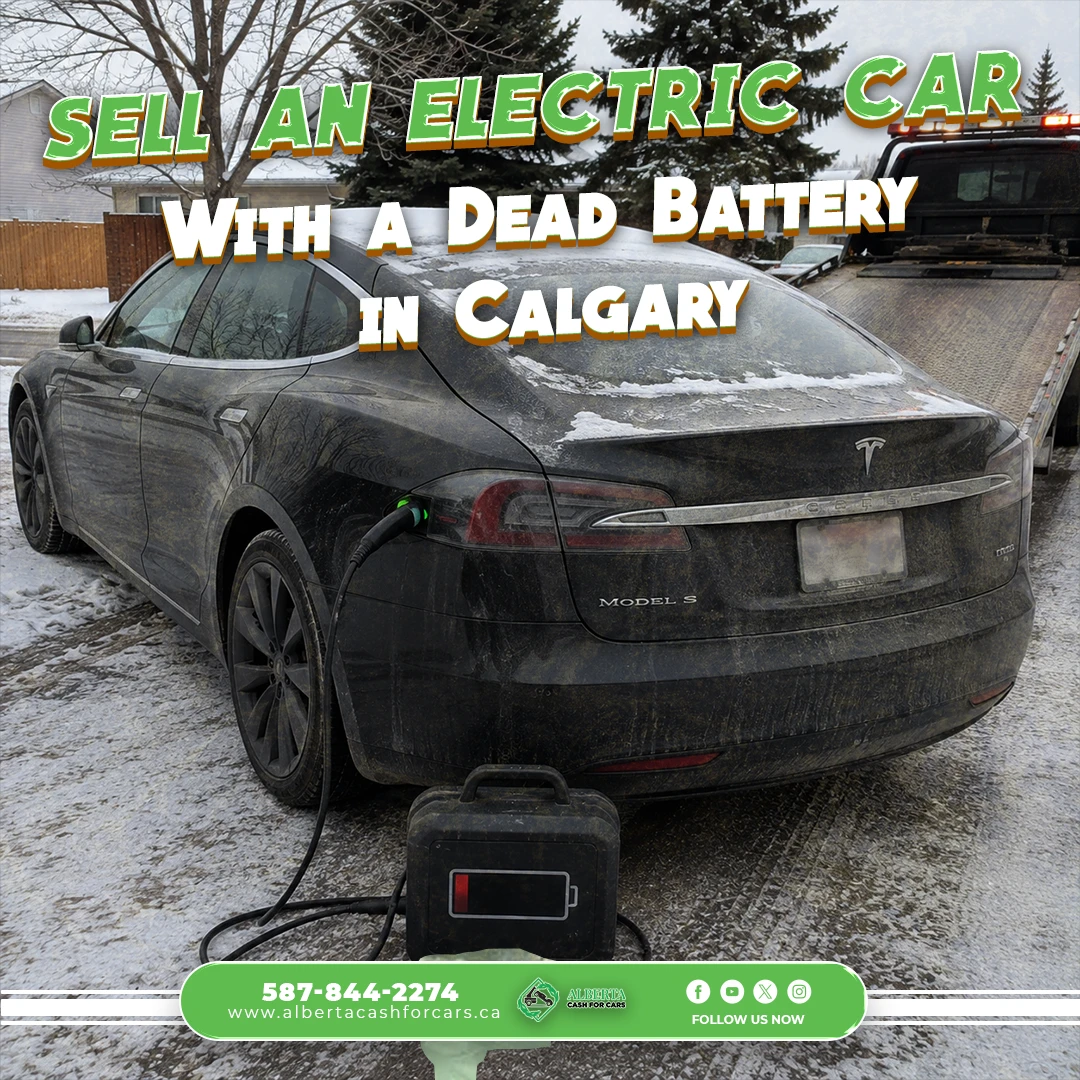




Can You Sell an Electric Car With a Dead Battery in Calgary?

Updated on: August 28, 2026

18 mins to read

Updated on: August 28, 2026

18 mins to read
Sell an Electric Car With a Dead Battery
Why Sellers Trust Us
How It Works

Step 1

Request a Quote

Step 2

Receive an Offer

Step 3

Schedule Pickup

Step 4

Get Paid Instantly

Step 5

Removal and Paperwork

Table of Contents

Yes, you can sell an electric car with a dead battery in Calgary. The real decision is whether replacing the battery first would actually pay for itself. On an older EV, a full battery replacement can cost a large share of the vehicle’s current market value, and in some cases more than the car is worth outright, which flips the usual repair-versus-sell logic that applies to a gas vehicle with a blown engine. Getting this decision wrong means either spending thousands on a repair that doesn’t come back in the sale price, or accepting a lowball offer from a buyer who assumes the whole vehicle is worthless because it won’t hold a charge.

If you’re trying to sell an electric vehicle with battery problems, a used EV with battery issues, or one that simply won’t start, this guide walks through what the battery actually means for its value, what replacement really costs, and how Calgary’s climate factors into the decision.

Ready to Sell Your EV, Battery Problems Included?

If you’re dealing with common car issues on an electric vehicle and the battery repair quote doesn’t make financial sense, cash for cars Calgary through Alberta Cash for Cars evaluates EVs based on real condition, battery included. We serve Calgary and more than 50 Alberta communities. Get a quote or email [email protected] for a free, no-obligation quote.

Can You Legally Sell an Electric Car With a Dead Battery?

Yes. Alberta doesn’t require a private seller to provide a Mechanical Fitness Assessment, the inspection document licensed dealers must give buyers before selling a used vehicle. What matters is being upfront about the battery’s actual condition, since this affects an EV’s value more than almost any other single factor.

What Counts as a "Dead" Battery?

This term gets used loosely, and the actual situation matters for how you approach a sale.

Situation What it means
Completely dead, won't power on at all Likely a full pack failure or a critical fault
Degraded with reduced range Battery still works but holds less charge than new
Won't charge Could be the battery, the charging system, or the onboard charger
Vehicle can't be driven Any of the above severe enough to make the car undrivable

These are genuinely different problems with different repair costs, so getting an actual diagnosis before assuming the worst is worth the time. A battery that still won’t charge after the vehicle has warmed up can indicate a fault requiring diagnosis, but that alone doesn’t confirm the pack itself has failed. Selling an electric car that won’t charge is often more straightforward than owners expect once the actual cause is known.

How Much Does It Cost to Replace an EV Battery?

These figures are industry estimates from North American sources, not Calgary shop quotes, and the underlying data is primarily reported in US dollars.

Vehicle category Reported installed cost (US$)
Small pack (Nissan Leaf 24-30 kWh) $4,000 to $9,000
Mid-size pack (Chevy Bolt, early Model 3) $7,000 to $14,000
Large pack (Tesla Model 3 Long Range, Model Y, Ioniq 5) $10,000 to $18,000
Flagship pack (Tesla Model S, Model X) $15,000 to $25,000+

Costs vary by battery chemistry, pack size, and whether the shop uses a new OEM pack or a refurbished one. A hybrid’s smaller battery typically costs $1,500 to $4,000 to replace, a fraction of what a full EV pack runs, which is worth knowing if you’re weighing the pros and cons of hybrid cars against a full EV for your next vehicle. According to industry pricing research from EV specialist sites MotorWatt and VoltChek, third-party remanufactured packs can reduce the cost by 30 to 50 percent compared to a dealership quote. Many new EVs come with long battery warranties, often around eight years, but coverage terms and mileage limits vary by manufacturer and model, so it’s worth checking whether a battery is still covered before paying for a replacement out of pocket.

It’s also worth knowing that battery replacement is genuinely rare: data cited by MotorWatt from Recurrent Auto’s dataset of more than 20,000 tracked EVs found an actual replacement rate of only about 2.5 percent, with most of those being early, high-mileage vehicles well over a decade old. This helps calibrate expectations, a dead battery on a relatively young EV is unusual and worth confirming isn’t something else entirely, like a charging system fault.

Are There Cheaper Repair Options Than a Full Replacement?

Sometimes. If only one or two modules within the pack have degraded rather than the whole unit failing, module-level repair can run $2,000 to $5,000 instead of a full pack replacement. Whether this is possible depends on the vehicle’s battery design and the manufacturer’s or service provider’s repair procedures, some EVs use structural battery packs or other designs that can limit the repair options available to technicians.

This comes up often for owners trying to sell a Tesla with a dead battery in Calgary specifically, since several Tesla models use this structural design, which narrows the repair path compared to older, module-based packs. A proper diagnosis from a battery specialist tells you which situation you’re actually in before you commit to a repair cost.

Repair vs. Sell As-Is: Doing the Math

The comparison here is simple to state but important to actually run with real numbers rather than assumptions.

Scenario What to weigh
Battery repair cost is a small fraction of the vehicle's value Repairing before selling can make sense on a newer, higher-value EV
Repair cost approaches or exceeds the vehicle's value Selling as-is is often the better financial option
Vehicle is older with other wear alongside the battery issue Repairing rarely recovers its cost in the sale price
You need the vehicle gone quickly Selling as-is avoids both the repair cost and the wait for parts

On an older EV specifically, battery replacement can represent a very large share of the vehicle’s current market value, which is why selling as-is becomes the more common outcome once owners get a real repair quote rather than guessing at the cost.

How Does Calgary's Winter Climate Affect This Decision?

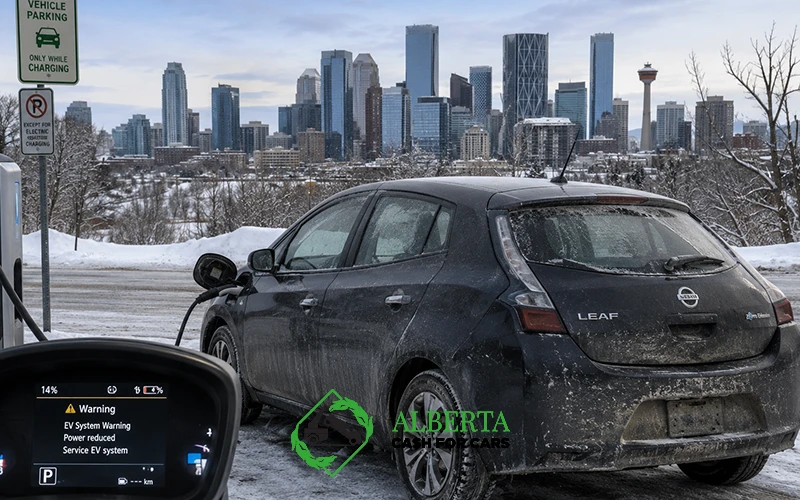
Calgary’s winter climate is important to this decision. Below-freezing conditions can typically reduce EV range by around 25 percent, according to research published by the University of Calgary. CAA’s real-world winter testing, conducted across a mix of highway and back roads in sub-zero Canadian conditions, found EVs driving 14 to 39 percent less than their official range ratings. That testing wasn’t conducted in Calgary specifically, but the sub-zero conditions it measured are directly relevant to what Calgary drivers experience through the winter.

The important distinction is that normal winter range loss is temporary and not a sign of battery failure, performance returns once temperatures warm up. A genuine battery fault looks different: range loss that doesn’t correlate with temperature at all, or error codes related to the battery’s thermal management system specifically. In our experience, most owners calling about a dead EV battery are dealing with a charging system fault rather than a full pack failure, which changes the repair math considerably, a charging issue is often a fraction of the cost of a pack replacement.

Some Calgary owners dealing with winter range loss and an aging battery decide their next vehicle should split the difference, which is part of why the best hybrid cars in Canada come up so often in these conversations. If you’re unsure which situation you’re dealing with, that’s exactly the kind of thing worth confirming with a diagnostic before assuming the worst about your vehicle’s value.
Sell an Electric Car With a Dead Battery

How Much Does a Dead Battery Reduce an EV's Value?

There’s no fixed percentage that applies across every EV, since the real answer depends on the vehicle’s age, mileage, overall condition beyond the battery, and how much a buyer estimates repair would cost. What’s consistent is that a dead or severely degraded battery creates substantial buyer uncertainty, since it’s one of the most expensive components to repair on the entire vehicle.

This EV battery failure value impact puts a vehicle with battery problems in similar territory to selling a damaged car for cash, where the buyer is pricing based on what’s actually usable rather than the vehicle’s original sticker price.

Who Buys an Electric Vehicle That Can't Drive?

Direct cash buyers evaluate EVs the same way they’d approach anyone who wants to sell a non-running car, based on what’s recoverable rather than expecting the vehicle to be drivable first. This includes the battery pack itself, which retains real value even when it’s no longer usable in the vehicle, along with the rest of the car’s components and metal weight.

What Happens to EV Batteries After Disposal?

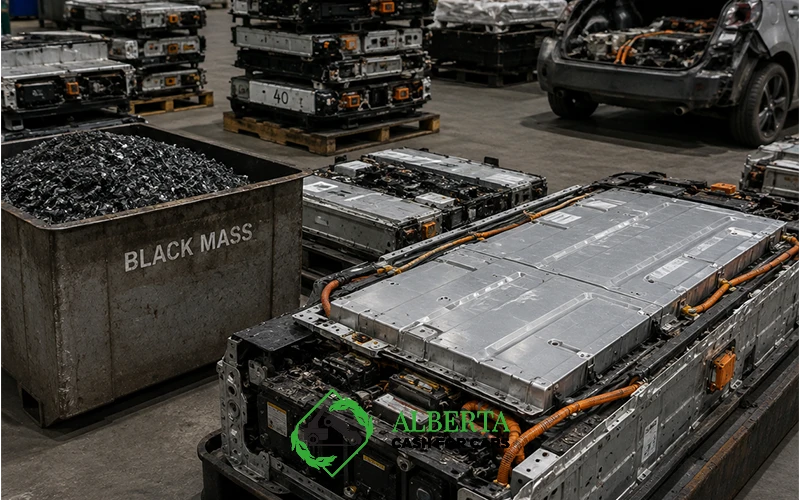
Canada doesn’t yet have a cohesive national end-of-life framework specifically for EV batteries. Management currently involves federal transportation and hazardous materials requirements alongside provincial rules and industry-led recovery programs, filling the gaps where no single national policy exists. Real recycling capacity does exist despite that gap. Companies process retired battery packs into what’s called black mass, a concentrated mixture of recoverable battery materials such as lithium, nickel, cobalt, and manganese, depending on the battery chemistry, which is then refined and sold back into the battery supply chain.

Some batteries that are no longer suitable for vehicle use can retain substantial capacity and may be repurposed for stationary energy storage before recycling becomes the final step. A vehicle with a dead battery isn’t simply scrapped and forgotten, a high-value component still has a real path forward.
What Happens to EV Batteries After Disposal?

Working EV vs. Dead-Battery EV: What Actually Changes

Working EV Dead-battery EV
Buyer pool Broad, includes private buyers Narrower, mostly direct buyers and parts specialists
Typical sale method Private sale or trade-in Direct cash buyer
Value driver Overall condition, mileage, range Battery pack's recoverable value, remaining components
Timeline Can take weeks for the right buyer Often same-day with a direct buyer

If you’re considering a hybrid for your next vehicle, hybrid car resale value tends to hold up more predictably than a full EV’s does, since a smaller, cheaper-to-replace battery removes a lot of the uncertainty a buyer would otherwise price in.

Frequently Asked Questions

Can you sell an electric car with a dead battery?
Yes. Alberta doesn't require a private seller to provide a Mechanical Fitness Assessment before selling a used vehicle. What matters is being honest about the battery's condition, since it's one of the biggest factors in what a buyer will offer.
How much is an EV worth with a failed battery?
It depends heavily on the vehicle's age, mileage, and overall condition beyond the battery itself. There's no fixed percentage, but a failed battery creates substantial buyer uncertainty, since it's one of the most expensive single components on the car to repair.
Should you replace an EV battery before selling?
Usually not on an older vehicle. Replacement costs commonly run $4,000 to $25,000 depending on the model, which can represent a large share of, or exceed, what an older EV is worth, making selling as-is the more financially sound choice in many cases.
Can cash car buyers buy electric vehicles?
Yes. Direct cash buyers evaluate EVs based on real condition rather than requiring them to be drivable first, factoring in the battery pack's recoverable value along with the rest of the vehicle's components and materials.
What happens to EV batteries after disposal?
Canada doesn't yet have one national recycling framework, so handling involves a mix of federal, provincial, and industry-led programs. Many retired batteries still hold substantial capacity and get repurposed for stationary energy storage, or are processed into recoverable materials like lithium and cobalt.
Does cold weather permanently damage an EV battery?
Not typically. Normal winter range loss, sometimes 14 to 39 percent in cold conditions based on Canadian testing, is temporary and reverses once temperatures warm up. A genuine fault looks different: range loss unrelated to temperature or thermal management error codes are signs of an actual problem.

The Bottom Line

Selling an electric car with a dead battery in Calgary is entirely legal, and for many owners, it turns out to be the more financially sound choice once the actual replacement quote comes in. Battery replacement can run into five figures, and on an older EV that often represents a large share of, or more than, the vehicle’s current value, which flips the usual repair-first instinct that applies to gas vehicles.

Calgary’s cold winters add real, temporary range loss on top of any underlying battery condition, so distinguishing normal seasonal performance from an actual fault matters before assuming the worst. Getting an honest repair quote and a realistic value estimate side by side is what actually determines whether fixing the battery is worth it, or whether selling as-is gets you further ahead.

References

Alberta Cash for Cars uses only trusted, high-quality sources to ensure the information in our articles is accurate, reliable, and up to date.

  1. University of Calgary – EVs in Alberta winter, cold weather battery performance
    https://ucalgary.ca/sustainability/mobilizing-alberta/climate-action-blogs/do-evs-work-cold-weather
  2. CAA (Canadian Automobile Association) – EV winter range testing results
    https://evbuyersguide.caa.ca/content/evs-in-winter
  3. Gowling WLG – How Canada is managing end-of-life EV batteries
    https://gowlingwlg.com/en/insights-resources/articles/2026/how-is-canada-managing-the-end-of-life-for-ev-batteries
  4. AMVIC (Alberta Motor Vehicle Industry Council) – consumer guidance on buying and selling used vehicles
    https://www.amvic.org/consumer/buying-a-vehicle/buying-used/
  5. Government of Alberta – Mechanical Fitness Assessments for used vehicles
    https://www.alberta.ca/mechanical-fitness-assessments-for-used-vehicles
  6. MotorWatt – EV battery replacement cost 2026, brand-by-brand pricing and replacement-rate data
    https://motorwatt.com/ev-blog/trends/ev-battery-replacement-cost
  7. VoltChek – EV battery replacement cost guide, model-level estimates and remanufactured pack savings
    https://voltchek.app/blog/ev-battery-replacement-cost-guide

Ready to Sell Your EV, Battery Problems Included?

If you’re dealing with common car issues on an electric vehicle and the battery repair quote doesn’t make financial sense, cash for cars Calgary through Alberta Cash for Cars evaluates EVs based on real condition, battery included. We serve Calgary and more than 50 Alberta communities. Get a quote or email [email protected] for a free, no-obligation quote.

We'll Buy Your Car Today
Any make. Any condition. Alberta-wide.

"*" indicates required fields

What Alberta Sellers Say

Ready to Sell Your Truck in Alberta?

We buy trucks and all vehicle types across Alberta, running, damaged, junk, or non-running. Free towing. Cash on the spot. No hassle.

Prefer to talk? Call us now:

Get Your Free Cash Offer in Minutes

"*" indicates required fields

This field is for validation purposes and should be left unchanged.

Get Your Free Cash Offer in Minutes

"*" indicates required fields

This field is for validation purposes and should be left unchanged.

Rayan Anderson

Alberta Cash For Cars Author

Alberta Cash for Cars is a Calgary-based, AMVIC-licensed vehicle buying company that purchases all vehicle types across Alberta in any condition, offering free towing and same-day cash payment.

Ryan Andersson is a Calgary-based writer specializing in automotive topics and Alberta-focused insights. He produces well-researched, fact-checked articles using reputable industry sources, market data, and local expertise to ensure accurate, practical, and trustworthy information readers can rely on.

Have Any Question?

Share:

What Alberta Sellers Say

Why Sellers Trust Us

How It Works

Step 1

Request a Quote

Step 2

Receive an Offer

Step 3

Schedule Pickup

Step 4

Get Paid Instantly

Step 5

Removal and Paperwork

Step 1

Request a Quote

Step 2

Receive an Offer

Step 3

Schedule Pickup

Step 4

Get Paid Instantly

Step 5

Removal and Paperwork

Our Recent Blog Posts

Discover quick answers, smart tips, and step-by-step insights to make selling your car easier and more profitable.

Sell an Electric Car With a Dead Battery

Can You Sell an Electric Car With a Dead Battery in Calgary?

Yes, you can sell an electric car with a dead battery in Calgary. The real

sell a car while It's impounded

Can You Sell a Car While It’s Impounded in Calgary?

A car sitting in a Calgary impound lot doesn’t stop costing money just because it’s

Can You Sell a Car With Bad Brakes in Calgary? Repair or Sell As-Is

Can You Sell a Car With Bad Brakes in Calgary? Repair or Sell As-Is

You can sell a car with brake problems in Calgary, whether privately or to a

Sell Luxury Cars for Cash in Calgary

How to Sell Luxury or High-End Cars for Cash in Calgary

Selling a luxury or high-end car for cash in Calgary isn’t the same process as