


Most people look at a dead car and see nothing but a problem to solve. That mindset costs them real money. A non-running vehicle can still hold hundreds, sometimes thousands, of dollars in salvageable components, and not knowing that means accepting the first lowball offer or giving it away outright. Knowing which parts hold value changes everything. In Alberta, where repair costs keep rising and demand for used auto parts remains strong year-round, this knowledge matters whether you’re selling a junk car or shopping for affordable replacements.
This guide covers the most valuable parts in a junk car, why buyers and recyclers pay well for them, and how to buy and sell used auto parts in Alberta without leaving money behind.
The Most Valuable Parts in Your Junk Car
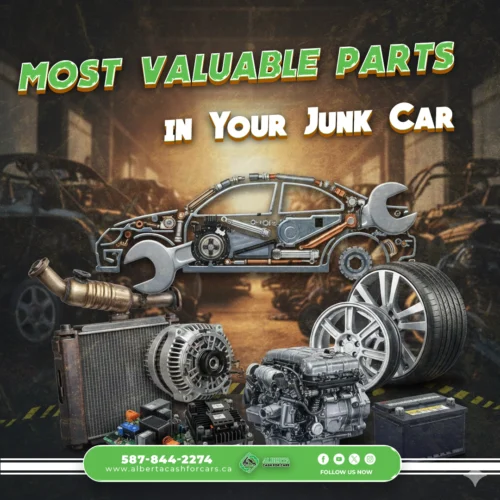
Some components consistently return more than others. Here is where the value actually sits.
Catalytic Converter: The Highest-Value Part in Any Scrap Vehicle
The catalytic converter is typically the single most valuable component in a junk or scrap car. It contains platinum (Pt), palladium (Pd), and rhodium (Rh), three precious metals that convert harmful exhaust gases into safer emissions. A standard passenger vehicle converter holds roughly 3 to 7 grams of platinum and 1 to 2 grams of rhodium, according to USGS Mineral Commodity Summaries [2]. As of 2026, most catalytic converters are worth $50 to $250 in scrap, while high-value units from vehicles like the Toyota Prius or large diesel trucks can fetch $300 to $700 [3]. PGM prices fluctuate with global commodity markets, so timing and vehicle type both affect the final number. Catalytic converter theft has been documented extensively across Canada in recent years, which alone reflects how much these components are worth [6].
Engine and Transmission: The Big-Ticket Cores
Functioning or partially functioning engines and transmissions attract buyers from rebuilders and remanufacturers across Alberta and beyond. Even a seized engine holds “core” value, meaning a buyer will purchase it for parts or refurbishment. Popular V8 truck engines from common North American platforms command the strongest prices. A usable engine from a well-known platform can bring several hundred to a few thousand dollars depending on make, model, mileage, and condition.
Car Battery: Small Component, Consistent Return
Lead-acid car batteries are among the most successfully recycled products in North America, maintaining a confirmed 99% recycling rate as of 2025, according to the Battery Council International [4]. A typical new lead-acid battery contains more than 80% recycled material, meaning your old battery feeds directly back into the supply chain. Even a dead battery holds core value. Most Alberta scrap yards and auto parts retailers accept them, often applying a credit toward a replacement purchase.
Wheels and Tires: Alloy vs. Steel Makes a Significant Difference
Aluminum alloy wheels return considerably more than steel rims because aluminum trades at a much higher scrap rate per pound. If the wheels are in good condition with no major bends or cracks, selling them as used parts rather than scrap increases the return further. Tires with remaining tread can be sold individually or as a set, particularly common SUV and truck sizes that move quickly through Alberta private listings.
Alternator and Starter: Copper-Bearing Components with Ongoing Worth
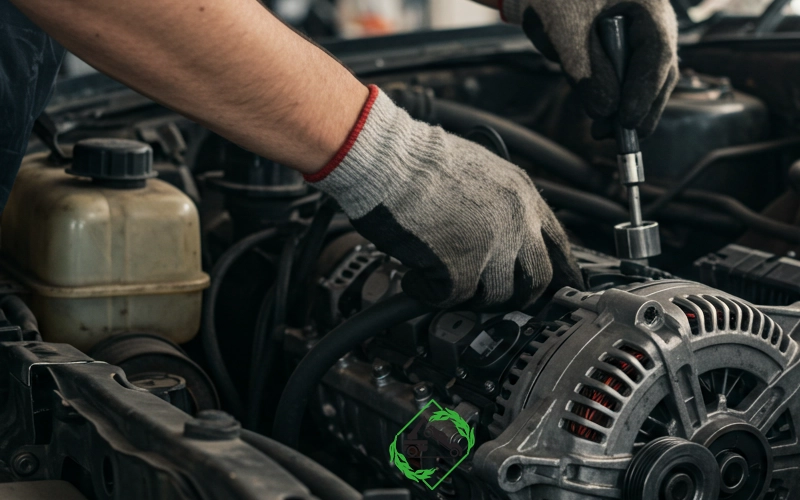
Both the alternator and starter contain copper windings that hold scrap value regardless of whether they work. When functional, they are candidates for remanufacturers who refurbish and resell under core-charge programs. The core charge applied at parts stores when buying new units reflects exactly this ongoing material value.
Radiator and AC Compressor: Metal Content Drives the Price
Copper-brass radiators are consistently sought by scrap dealers and fetch the highest return per pound. Aluminum-core radiators also carry solid scrap value. AC compressors are similarly recycled for their internal metals and are often rebuilt for resale. Neither part requires the vehicle to be running, which makes them straightforward to pull and sell separately.
Body Panels, Headlights, and Electronics: Frequently Overlooked Value
Factory LED and HID headlight assemblies from popular models can sell for significant amounts through private listings, since collision-damaged vehicles often need a single working replacement at a fraction of the new cost. Infotainment systems and GPS modules from luxury or late-model vehicles are also worth removing before scrapping the rest. The vehicle’s steel body contributes to overall scrap weight as well, and heavier trucks and SUVs naturally return more through that channel.
How to Buy Used Auto Parts in Alberta Without Wasting Money
The same parts that hold value in a junk car are exactly what buyers across Alberta are actively looking for [5]. Knowing where to source them and how to verify quality before paying saves you from expensive mistakes.
Where to Find Used Auto Parts in Alberta
| Source | Best For | Key Trade-off |
|---|---|---|
| Local Auto Wreckers and Junkyards | Hands-On Inspection, Self-Pull Options | Time Investment Required |
| Online Listings (Kijiji, Facebook Marketplace) | Wide Selection, Competitive Pricing | Variable Quality and Seller Reliability |
| Specialty Auto Recyclers | Organized Inventory, Province-Wide Shipping | Slightly Higher Prices |
| Car Forums and Model-Specific Clubs | Rare, Vintage, or Performance Parts | Smaller Selection |
| Private Sellers | Classic and Off-Road Vehicle Parts | Due Diligence Required |
Combining two or three of these sources gives the best balance of price, selection, and reliability for most parts.
Verifying Fit and Condition Before You Pay
Compatibility problems are the most common reason a used parts purchase fails. Always cross-reference the part number against the year, make, and model of your vehicle. For electronics, confirm the wiring harness style, connector type, and software version. Searching by VIN gives the most accurate match.
For mechanical parts, check for cracks, heavy corrosion, worn bearings or seals, and any grinding or binding movement. For electronics, ask the seller to bench test the unit and look for moisture damage or burnt contacts. Parts from low-mileage highway vehicles consistently outlast those pulled from wrecked or off-road trucks.
Red flags to walk away from:
- Sellers who refuse to share photos or part numbers
- No return policy on electronics or mechanical components
- Unclear or missing vehicle history
- Prices that look too low for high-value parts like catalytic converters or engines
Turn Your Old Vehicle Into Cash With Alberta Cash for Cars
If your vehicle is no longer worth repairing and you would rather not part it out yourself, Alberta Cash for Cars makes the process simple. The team buys vehicles across Calgary and approximately 25 surrounding Alberta communities, handling pickup, towing, and all paperwork. Here is what sellers get:
- Instant quotes with no hidden fees
- Cash paid at pickup, every time
- Same-day pickup available in most areas
- Free towing for non-running, junk, and scrap vehicles
- Fair offers on running, used, damaged, accidental, and flooded cars
Whether your car has valuable parts still intact or is beyond recovery, the process is straightforward. Reach out for a free quote and turn your old car into cash without the hassle of parting it out piece by piece.
Conclusion
A junk car holds more value than most owners realize. The catalytic converter, engine, battery, wheels, alternator, and electronics all carry real market worth, and knowing that puts you in a much stronger position before you pick up the phone. On the buying side, Alberta’s used auto parts market offers solid savings for anyone willing to verify compatibility and condition before committing. Whether you are selling a vehicle that has reached the end of its useful life or sourcing affordable replacement parts, the same principle applies: know what you are working with, get multiple opinions, and do not rush. That approach consistently delivers better outcomes than going with the first option available.
FAQs
What is the most valuable part in a junk car?
How do I know if my junk car's engine is worth selling separately?
Are used auto parts from Alberta junkyards reliable?
Can I sell a junk car in Alberta without registration documents?
What is the difference between a salvage yard and a cash-for-cars service in Alberta?
Sources
Alberta Cash for Cars uses only trusted, high-quality sources to ensure the information in our articles is accurate, reliable, and up to date.
- IMARC Group. Global Vehicle Recycling Market Size, Share, and Forecast 2026–2034. https://www.imarcgroup.com/vehicle-recycling-market-statistics (Published January 2026)
- U.S. Geological Survey. Mineral Commodity Summaries 2025: Platinum-Group Metals. https://pubs.usgs.gov/periodicals/mcs2025/mcs2025-platinum-group.pdf
- JunkyardInventory.com. Catalytic Converter Scrap Prices by Vehicle (2026). https://junkyardinventory.com/blogs/cat-converter-scrap-prices (Updated May 2026)
- Battery Council International. New Study Confirms Lead Batteries Maintain 99% Recycling Rate. https://batterycouncil.org/news/new-study-confirms-lead-batteries-maintain-remarkable-99-recycling-rate/ (Published December 2025)
- Alberta Motor Vehicle Industry Council (AMVIC). Buying and Selling Used Vehicles in Alberta. https://www.amvic.org/consumers/buying-a-vehicle/
- RRCats.com. Inside a Catalytic Converter: A Scrapper’s Guide to Precious Metals and Value. https://rrcats.com/blog/inside-a-catalytic-converter-a-scrappers-guide-to-precious-metals-and-value/ (Published April 2026)